Home

Home

  • Supply-chain language and market reactions
  • Predicting Hacker News engagement
  • Reconstructing Adam experiments

About me

I work on machine learning and empirical analysis for questions about supply chains, firms, and markets. My current research measures supply-chain risk in corporate disclosures and examines its relationship with stock-market reactions. My projects also examine how modeling and evaluation choices affect prediction, from chronological validation to numerical optimization.

My background is in mechanical engineering and manufacturing. At Apple, I worked on product design, validation, and failure analysis. After leaving Apple, I designed a robotic system for performing maintenance on autonomous vehicles. Shortly after, I founded Reframe, an AI procurement tool for mechanical hardware, as part of Y Combinator’s W26 batch.

I am seeking research associate and fellowship opportunities in applied machine learning and operations research as I prepare for doctoral study.

Selected work

  • Supply-chain language and market reactions: A 2010–2019 study combining dictionary-based NLP, event studies, and an investigation of how tied scores affect portfolio comparisons. Research overview
  • Predicting Hacker News engagement: Chronological evaluation of prediction models on a corpus of 4.7 million posts, with an emphasis on data quality and information available at submission. Selected projects
  • Reconstructing Adam experiments: NumPy implementations of five optimizers and manual backpropagation, including an investigation of results that differ from the original paper. Code and experiments

I hold a B.S. in Mechanical Engineering from Cornell University.
Research

Research

Supply-chain language and stock-market reactions

Research direction

I am interested in how firms make operational decisions under uncertainty, how disruptions move through production networks, and what can be learned about these processes from text and market data. My current work focuses on measurement and empirical evaluation. Longer term, I want to develop computational models that help evaluate how operational and policy decisions affect firms and markets.

Supply-chain language and stock-market reactions

Independent research · 2026 · Ongoing

Question. Is the language managers use to discuss supply-chain risk and its resolution associated with abnormal stock returns around earnings announcements?

Data and methods. The analysis covers 58,305 earnings calls from 2,200 companies covering 2010–2019. The final portfolio sample contains 52,533 calls from 2,026 firms after market-data and industry-classification filters. The study uses reconstructed supply-chain, risk, and resolution dictionaries, with the supply-chain vocabulary derived using PPMI and truncated SVD. I compare text measures with cumulative abnormal returns from a Carhart four-factor model.

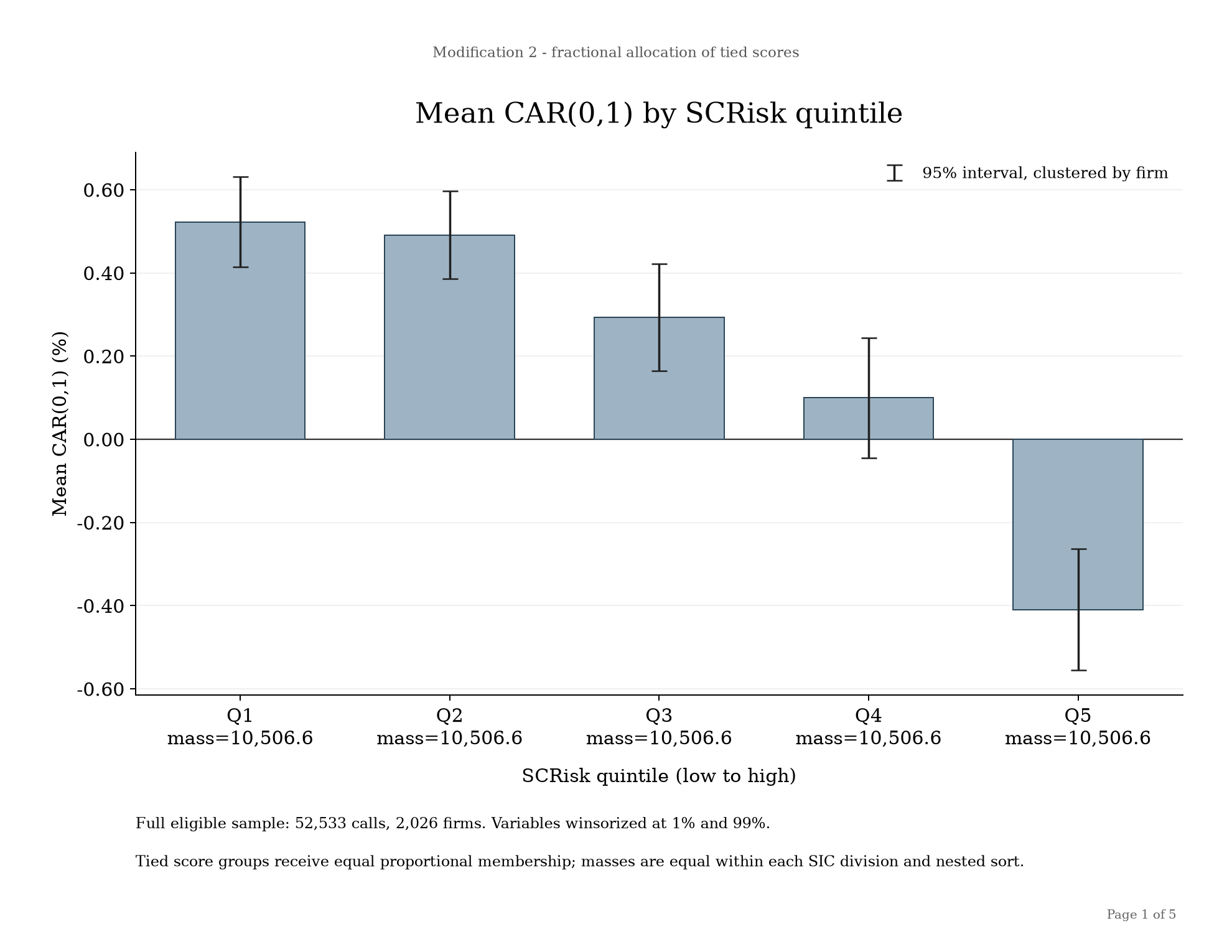
Current finding. Mean two-day abnormal returns decline from +0.52% in the lowest fractional risk portfolio to −0.41% in the highest. The input data produced a significant number of supply chain risk scores with a value of zero, spanning the entirety of the first quintile and much of the second.

Mean two-day abnormal returns decrease across fractional risk portfolios, from 0.52% in Q1 to −0.41% in Q5; error bars show firm-clustered 95% intervals.
Mean CAR(0,1) by fractional SCRisk portfolio, 2010–2019. Bars show 95% intervals clustered by firm. Final sample: 52,533 calls from 2,026 firms. Portfolios share observations when scores are tied.

Scope and limitations. Events use reported earnings-release dates, which may differ from conference-call dates; the analysis makes no after-hours adjustment. Portfolio intervals account for repeated observations within firms; the analysis does not yet include controlled regressions or common-date dependence.

Next question. I plan to examine a separately defined subset of hardware companies with documented international supply-chain exposure, retaining the full-sample baseline.

Projectsfolder
Projects
  • Predicting Hacker News engagement
  • Reconstructing Adam optimization experiments
  • Technical preparation

Predicting Hacker News engagement

Independent project · Baseline evaluation complete; embedding experiments in progress

How much of a post’s eventual engagement can be predicted using information available when it is submitted?

I designed and orchestrated the project. The Python pipeline processes 4,739,207 usable Hacker News stories and identified periods where archived scores reflected submission-time snapshots rather than mature outcomes. After excluding those periods, the baseline evaluation uses 3,568,252 training posts from 2006–2022 and 599,937 test posts from 2024–2025. Historical author and domain features use earlier observations with a score-settling lag.

I compared simple historical baselines, Ridge regression, and XGBoost. The combined-feature Ridge model achieved a test Spearman correlation of 0.297, compared with 0.050 for the trailing-mean baseline. RMSE on log-transformed scores improved by about 3.6%, showing that the features helped ranking more than prediction of score magnitude. XGBoost remained behind Ridge on ranking after early stopping.

The project also includes PyTorch implementations of CBOW and skip-gram objectives with negative sampling, with targeted training experiments on text8. The full embedding variants and their downstream Hacker News comparison remain unfinished.

Tools: Python, pandas, scikit-learn, XGBoost, PyTorch.

Reconstructing Adam optimization experiments

Independent implementation study · MNIST experiments complete

I implemented Adam, AdaGrad, RMSProp, AdaDelta, and SGD with Nesterov momentum in NumPy, together with manual forward and backward passes for logistic regression and a multilayer perceptron.

The experiments revisit optimizer comparisons from Kingma and Ba’s Adam paper. In my 200-epoch MNIST experiment with dropout, AdaGrad reached a lower final training loss than Adam, differing from the paper’s reported ordering. I documented that discrepancy and possible explanations involving the tuning horizon and gradient sparsity; these remain hypotheses rather than established causes.

The project demonstrates numerical implementation, experiment design, and diagnosis of reproduction gaps. The CIFAR-10 extension is unfinished.

Repository

Technical preparation

Programming languages: Python.

Methods demonstrated in projects: Text processing, dictionary-based NLP, chronological model evaluation, feature engineering, linear and tree-based prediction, numerical optimization, manual backpropagation, and event-study analysis.

Libraries and tools: NumPy, pandas, PyTorch, scikit-learn, XGBoost, Git, and automated testing.

Additional study: Reinforcement learning, Markov decision processes, and policy optimization through independent coursework.

CVclipboard

CV

  • Reframe Innovations
    Founder · 2026
  • Apple
    Product Design Engineer III · January 2022–May 2025
  • Freshfleet
    Mechanical design
  • Education

Reframe Innovations

Founder · 2026

At Reframe, we built procurement automation for hardware teams, connecting bill-of-materials planning, supplier communication, sourcing, and purchasing workflows. The application uses TypeScript, Supabase, TanStack Query for server state, Jotai for UI state, and Trigger.dev for Gmail synchronization and background workflows.

We evaluated negotiation behavior by labeling supplier conversations, documenting effective and ineffective tactics, and constructing preference pairs. We used these pairs to fine-tune gpt-oss with direct preference optimization through Unsloth.

Apple

Product Design Engineer III · January 2022–May 2025

I worked on mechanical design, structural integration, and validation for iPhone 15 Pro Max, iPhone 17, and iPhone 17 Air. I developed validation protocols, analyzed yield and failure data, and worked with engineering and manufacturing teams across the United States, China, India, and Singapore.

Freshfleet: robotic cleaning end effectors

Mechanical design case study · Write-up in preparation

At Freshfleet, I designed compliant end effectors for cleaning vehicle seats and floors with a UR10e robot arm, including the cleaning mechanism, electronics, and actuation.

CAD renders and a write-up of the end-effector design are in preparation.

Education

Cornell University — B.S. in Mechanical Engineering · December 2021

Resume

Resume

Bryan Zin resume

Drag anything around.

Click a folder to open it.